



BRAND GROWTH CAMPAIGNS

Solve real commercial problems with focused marketing activity

Marketing can be used to overcome a number of commercial problems. For many firms in regulated markets, it’s not always winning new business that needs attention. Sometimes the issue is recruitment. Sometimes it’s onboarding friction. Reputation. Referrals. Retention. Or staying credible and top-of-mind while you’re running the firm.

Brand growth campaigns apply focused marketing to the bottleneck in front of you, with the accuracy and standards regulated firms need.

If you want a campaign built around a clear commercial goal, get in touch.

Let's get started


Trusted by professional services

WHY

Remove friction from the growth engine

When a constraint hits in regulated markets, it rarely stays contained. Trust-driven sectors like law, finance, and healthcare face many of the same commercial pressures.

Hiring gaps cap capacity. Slow onboarding delays revenue and makes cashflow harder to forecast. When services become commoditised, price pressure compresses margins and pushes firms toward volume, which then strains service delivery. The result is the same: leadership time disappears into operational firefighting, and growth becomes harder to control.

They’re not the only constraints, but they all create the same compound effect: less control, more wasted time, and a higher risk of good opportunities going elsewhere.

A focused campaign gives you a practical way to remove your bottleneck and move growth forward. The point is to give people a reason to act, whether that’s choosing you, referring you, or joining you.

HOW

Focused campaigns, built around a clear commercial goal

Brand growth campaigns are built to remove the bottlenecks that slow progress. Each campaign starts with the outcome that needs to move, the audience it needs to reach, and the message that will stand up in a regulated environment. From there, the right campaign approach is applied, with clear ownership and reporting that stays commercially relevant.

Turn a commercial priority into a campaign plan

Campaign and content planning

Whatever challenge you’re trying to solve, this is where it starts. We define the outcome that needs to move, the audience it needs to reach, and the message that will stand up in a regulated environment. From there, the campaign is planned with clear themes, deliverables, timelines, and sign-off points, so delivery is organised, consistent, and measurable rather than reactive.

Be the firm talent want to join, and thrive in

Employer branding and recruitment marketing

In professional markets like law, finance and healthcare, good candidates don’t move lightly. Recruiting works best when you reduce uncertainty and proudly demonstrate what the opportunity and environment are really like. This growth campaign uses strategy and positioning, recruitment content, and channel optimisation so candidates can understand progression, expectations, and culture before they apply, improving fit and attracting the best talent.

Maximise commercial opportunities already in your network

Client retention, reactivation, and referral campaigns

Most firms have repeat work and referral potential sitting in existing relationships, but no structure to activate it. These campaigns create planned, useful touchpoints that keep clients warm, reopen dormant conversations, and make it easier for referrers to introduce you confidently. The outcome is more repeat instructions and introductions, without relying on cold outreach or constant posting.

Reduce onboarding friction with fast, reassuring follow-up

CRM and marketing automation

In law, finance, and healthcare, people often reach out when something feels urgent or sensitive. They may contact several providers, and the firm that responds quickly and sets clear expectations is usually the one that earns trust first. This work builds a consistent follow-through process through your CRM: immediate acknowledgement, the right information captured early, and clear next steps delivered automatically. It reduces delay, removes inconsistency, and helps more good-fit enquiries convert into clients without lowering standards.

Strengthen trust signals and protect reputation

Reputation and review management

In trust-driven markets, people often validate their decision outside your website. If reputation signals are thin, outdated, or inconsistent, good opportunities hesitate. And if you’ve had poor reviews, unmanaged feedback can quietly shape perception long after the issue has been resolved. This work puts structure around how trust signals are built and handled, from review strategy and response principles to how reputation is presented across key touchpoints, so credibility is reinforced consistently and risk is managed calmly.

Win recognition through industry awards and rankings

Partnerships and directory strategy

Being independently recognised can strengthen credibility and reduce hesitation at the point of choice. This campaign runs as a structured submissions and evidence programme: selecting the right awards or rankings, building a clear proof pack, shaping the narrative in compliant language, and managing the submission and referee process. When recognition is secured, it’s then applied across your website, recruitment, and outreach so it supports real commercial outcomes.

Have a specific commercial goal?

Bespoke brand growth campaigns

Not every campaign fits a neat category. If you have a clear priority, a new service to launch, a shift to communicate, or a stubborn conversion problem, a bespoke campaign can be built around it. The same rules apply: one outcome, clear messaging, clear ownership, and reporting that shows whether it’s working. If there’s a commercial priority you want to move, get in touch and we’ll scope the right campaign.

Keep campaigns accountable and improving over time

Analytics, insights, and performance optimisation

Every campaign needs a clear view of what’s working and what’s wasting effort. Analytics and performance optimisation sets simple tracking and reporting against the outcome you care about, whatever commercial goal you’re aiming towards. Those insights then inform refinements to messaging, audience targeting, channel selection, and content priorities. The aim is informed decisions, steady progress, and campaigns that keep improving against the goal.

CASE STUDIES

Brand growth campaigns in practice

When campaigns are focused and executed with purpose, they can shift a real business constraint. These examples show how focused brand growth campaigns delivered measurable commercial results.

Doubling enquiries through a personality-led brand growth campaign

Sophie’s Kitchen Sussex had strong local relationships, but online engagement and enquiries had plateaued. The goal was to revitalise the brand in a way that felt professional, reflected Sophie’s personality, and could be rolled out quickly without increasing spend.

Strategic focus

  • Seasonal campaigns using audience-focused storytelling to keep the brand visible and relevant
  • Refreshed visual content that showcased catering expertise and made the offer easier to understand
  • Conversational, sensory caption writing designed to increase engagement and drive action

Outcome

A full refresh delivered in two weeks, followed by six months of measurable uplift: reach up 44%, profile visits up 45%, follower growth up 217%, and a 103% increase in social media–attributed enquiries (28 to 57), without additional spend.

Building momentum through an anniversary-led campaign and faster follow-through

Leonard Solicitors LLP needed a clearer public-facing message while leadership broadened the firm’s services. At the same time, enquiry handling and onboarding were inconsistent, which risked losing good opportunities even as visibility improved. The work combined a campaign-led market message with operational follow-through through CRM and automation.

Strategic focus

  • A single anniversary campaign theme, “For Every Stage of Life”
  • Consistent rollout across website, email, social, and staff signatures
  • RedView CRM to capture and track enquiries, with automated replies and clearer next steps
  • Streamlined intake workflows and templates to speed up information gathering and improve consistency
  • Ongoing trust-building through stronger online presence, reviews, and regular client updates

Outcome

A clearer, more consistent presence in the market, supported by faster and more reliable enquiry handling. The programme contributed to a 164% increase in turnover, alongside measurable operational improvements including a 34% increase in new files opened and onboarding accelerated by around 3–5 days. Organic enquiries became steady enough to reduce reliance on paid ads.

Professionals assessing brand growth campaigns success

WHO

Brand growth campaigns for priority commercial opportunities

When you’re running a firm that provides high stake services, most weeks are spent balancing delivery, people, and risk. On top of that, growth often stalls for practical reasons, even when you’re doing good work.

When it does, leadership attention gets dragged into operational fixes. The business stays busy, but momentum suffers and opportunities are missed.

Brand growth campaigns are designed for firms who recognise one or more of the following:

  • You have a clear commercial priority, but it keeps slipping behind urgent operational work
  • Recruitment is limiting capacity, and good candidates are not choosing you quickly enough
  • You’re losing good opportunities because the firm is not staying visible or memorable between engagements
  • Referrals matter, but they arrive inconsistently and you cannot influence them without structure
  • Your reputation signals are weak, outdated, or mixed, and it is creating hesitation before contact
  • You need to communicate change properly (new services, new focus, new standards) and want it handled with discipline

If you can name the outcome that needs to shift, a focused campaign is how you apply pressure in the right place, without creating noise or reputational risk.

Collaborate with me to overcome your growth challenges and create momentum on a commercial goal.

Let's talk
Professionals assessing brand growth campaigns success

SERVICES

Brand growth campaigns are where the ecosystem proves itself

Brand growth campaigns work best when they’re not covering the cracks of the wider marketing ecosystem. If the positioning is unclear, visibility is inconsistent, or the website isn’t converting well, even a strong campaign has to work twice as hard to create movement.

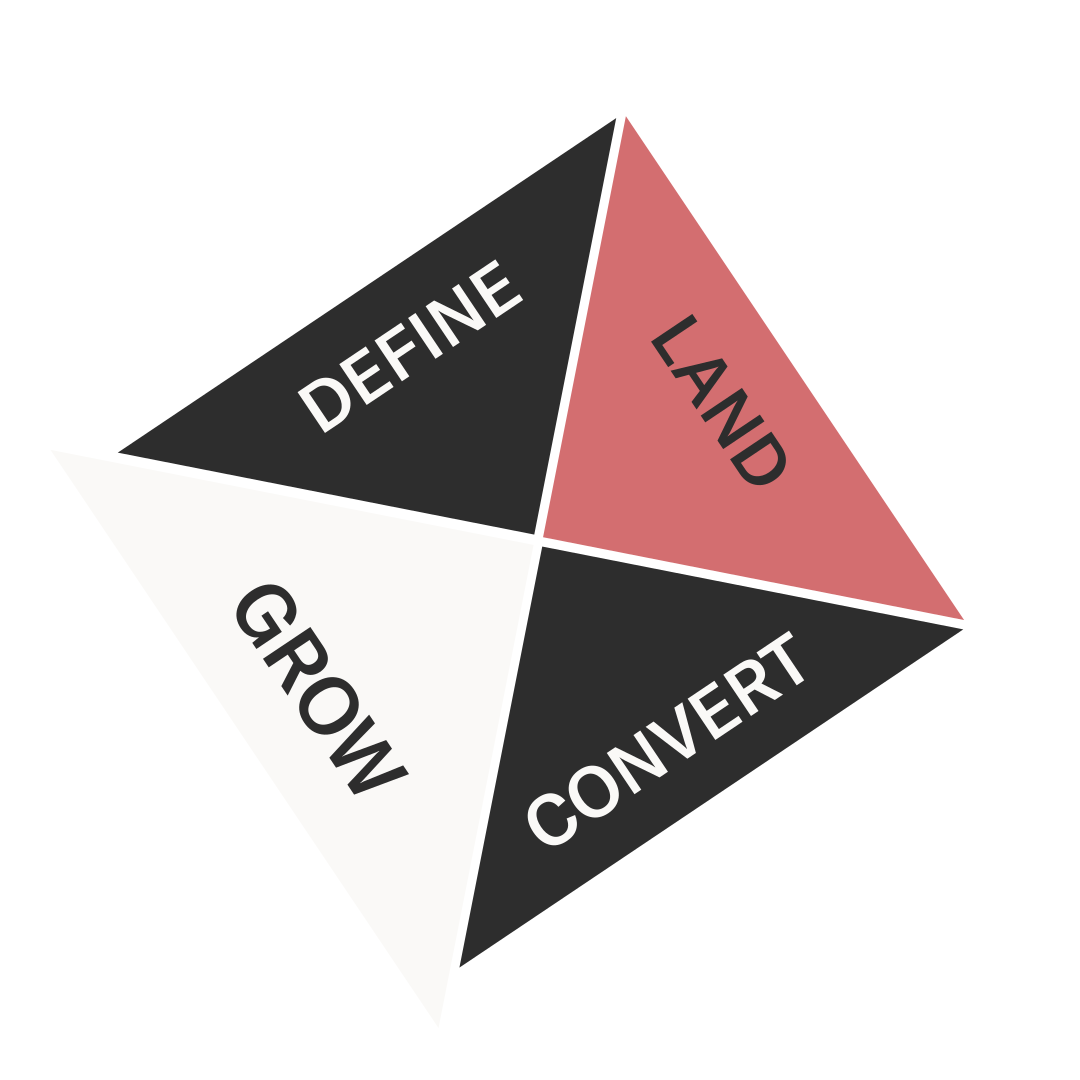
In my framework, this is the GROW stage. It follows DEFINE, LAND, and CONVERT. When those stages are in good order, campaigns can do what they’re supposed to do: build momentum on a specific commercial priority, reinforce credibility, and keep the firm visible in the moments that influence choice.

Marketing Ecosystem highlighting GROW: Brand Growth Campaigns

DEFINE

Brand & Marketing Strategy

DEFINE gives your marketing direction. It clarifies positioning, strengthens credibility, and creates a shared framework that informs how your firm competes and grows.

EXPLORE

LAND

Website Design & Conversion

Your strategy informs how your firm is presented online. LAND focuses on translating positioning into a credible, well-structured digital presence that supports confident decision-making.

EXPLORE

CONVERT

Discoverability & Lead Generation

Here we improve how your firm is found and chosen. It strengthens visibility, content, and credibility signals to support informed enquiries and consistent lead generation.

EXPLORE

QUESTIONS

Frequently Asked Questions

What is a brand growth campaign?

A brand growth campaign is a focused piece of marketing built around one clear commercial outcome.

It starts by defining what needs to move (for example: better recruitment response, more referrals, stronger reputation signals, higher conversion from enquiries, or communicating a change in the firm). From there, the campaign turns that outcome into a clear message, a defined audience, and a structured plan of activity across the most credible channels for your market.

The goal is not noise or constant posting. It’s a disciplined push that creates measurable momentum on the priority in front of you, while maintaining the standards and restraint regulated firms need.

What kinds of commercial problems can a campaign realistically solve?

A brand growth campaign can solve problems where the barrier is perception, confidence, or behaviour, and where focused marketing delivered consistently can shift an outcome.

In practice, that includes things like improving recruitment response by making the opportunity clearer, increasing repeat work and referrals through structured touchpoints, strengthening reputation signals that reduce hesitation, supporting industry recognition through awards and rankings, or helping the market understand a change in the firm (new service, new focus, new standards).

It’s not the right tool for everything. If the issue is primarily operational (service quality, resourcing, internal process failure), a campaign can’t “market it away”. It can support by making communication clearer and improving follow-through, but it won’t replace delivery fixes.

If you’re unsure, the simplest test is this: if you can define the outcome that needs to move and the audience whose behaviour needs to change, a campaign is usually a good fit.

What if we already have a brand or have recently rebranded?

Most campaigns can be planned and launched within 2 – 4 weeks, depending on how quickly the firm can provide inputs and approve content.

Week 1 is usually about pinning down the outcome, audience, messaging, and what proof points you can credibly use. Week 2 is building the core assets and the campaign plan (content, emails/posts, landing page or supporting material if needed). Launch timing then depends on sign-off, internal availability, and whether anything needs compliance review.

If the campaign is heavier (for example an awards submission programme, a recruitment push with new assets, or CRM automation setup), planning and launch can take longer because there are more moving parts and approvals. The faster the access and sign-off, the faster the campaign moves.

How soon should we expect to see impact?

Impact depends on what the campaign is trying to shift, and how warm the audience is.

For campaigns aimed at existing relationships (past clients, referrers, current followers, email lists), you can often see early signals within days or weeks: replies, calls booked, referral conversations restarting, stronger engagement, or an uplift in enquiries.

For campaigns aimed at market perception (reputation building, awards/rankings recognition, broader awareness), impact is usually slower and cumulative. You may see leading indicators quickly, but the commercial effect tends to build over 6 months, because trust and recall take repetition.

The most reliable way to think about it is: the nearer the audience is to you already, the faster the response. The further out you’re trying to shift perception, the more the campaign compounds over time.

What do you need from us to make a campaign work (time, access, sign-off)?

To make a campaign work properly, you mainly need clarity, access, and sign-off.

  • Clarity: what outcome you want to move, who it’s for, and any constraints (capacity, service lines to prioritise, what you do not want to promote).
  • Access: someone who can provide the facts and proof points quickly (wins, differentiators, policies, processes, case examples where appropriate), plus access to the platforms involved (website/CRM/email/social) or the person who manages them.
  • Sign-off: a clear approver and a realistic turnaround time. Campaigns slow down most when approvals are unclear or fragmented.

Timewise, it’s usually light but focused: a short kick-off, one or two working sessions to extract the substance, then quick reviews at agreed checkpoints. The more decisive the access and approvals, the faster the campaign delivers.

Who does the writing and creative, and how are approvals handled?

I handle the writing and campaign assets end to end. That includes the campaign message, content plan, copy for emails and LinkedIn, supporting landing-page or website copy where needed, and any lightweight creative direction for designers or existing brand templates.

Approvals are kept simple and controlled. We agree one lead approver at the start, set clear sign-off points (usually message ? key assets ? full rollout), and keep feedback contained to what moves the outcome. If compliance review is needed, copy is provided in a format that’s easy to review, with version control so nothing gets lost in threads.

The aim is to make approval predictable, not painful, and to protect tone, accuracy, and reputational risk while keeping the campaign moving.

Which channels do you use (LinkedIn, email, PR, events), and how do you decide?

Channel choice is driven by where your buyers actually validate trust and take action, not by what’s fashionable.

For most professional firms, that usually means a combination of:

  • Email for existing relationships (clients, referrers, networks) where response can be fast and measurable
  • LinkedIn for visibility, authority, and recruitment, especially when decision-makers and candidates are active there
  • Website as the reference point that supports credibility and the “next step”
  • PR, awards/rankings, and events where third-party validation or relationship building is the real lever

The mix depends on the goal. A recruitment campaign will lean differently to a referral campaign or an awards submission programme. The common rule is simple: choose the few channels most likely to shift the outcome, then execute consistently rather than spreading effort thin.

How do you run recruitment campaigns without overpromising or misrepresenting the role?

Recruitment campaigns work when they reduce uncertainty for the right candidates, without overselling or creating unrealistic expectations.

The focus is on evidencing what professionals actually care about before they move: the type of work, standards, supervision and development, progression, working patterns, and what the environment is really like. Messaging is written to be accurate and defensible, not “employer brand fluff”, and the content is designed to match what candidates will experience once they speak to you.

Practical outputs can include job page and advert copy, a clear employer narrative (why this role, why now), supporting content that shows the team and working culture, and a consistent approach to how roles are presented across the channels candidates use. The aim is better fit, fewer wasted applications, and faster decision-making from the candidates you actually want.

How do you strengthen referrals and repeat work without “salesy” comms?

Strengthening referrals and repeat work without “salesy” comms means giving people a useful reason to engage, and an easy way to introduce you, without pressure.

The work usually starts by clarifying three things: who you want referrals from, what work you want more of, and the signals that make someone a good fit. From there, a short sequence of touchpoints is built for past clients and referrers. The content is practical and relevant (updates, guidance, reminders of when to involve you), not promotional.

For referrals, the key is making it easy. That might be a simple “when to refer” guide, a short description referrers can forward, and a clear next step for introductions. For repeat work, it’s structured check-ins and reactivation messaging that keeps you top-of-mind, so people come back when the next need arises.

Can you improve follow-up and onboarding speed?

Yes. A campaign can improve early-stage follow-up and onboarding speed, but only where it’s appropriate and within the standards your firm needs.

This usually involves setting up a simple CRM-led process, so enquiries are captured consistently, acknowledged quickly, and routed properly. Automated messages can confirm receipt, set expectations, and explain next steps, while templates ensure the tone stays calm, accurate, and compliant. Where needed, the workflow can also gather key information early to reduce back-and-forth and speed up decision-making.

The aim is not to “automate relationships”. It’s to remove avoidable delay and inconsistency, so good-fit enquiries don’t cool off, and the first experience of the firm feels organised and reassuring.

How do you manage reputational risk, negative feedback, or poor reviews?

Reputational risk is managed by staying disciplined about what you publish, how you respond, and where you engage.

If reputation signals are thin, the focus is on building them steadily through a clear review approach and consistent presentation across the places people check. If you’re dealing with poor reviews, the priority is to respond calmly and professionally, avoid defensiveness, and show that issues are handled properly, without getting drawn into arguments or disclosing sensitive details.

This work sets response principles, tone guidance, and a simple process for monitoring and escalation, so reputation doesn’t get managed ad hoc. The aim is to reduce hesitation, protect credibility, and avoid small issues becoming bigger ones because they were ignored or handled inconsistently.

How do you measure campaign performance?

Campaign performance is measured against the one outcome the campaign exists to move, with a small set of indicators that show whether you’re getting closer to that outcome.

It usually works in three layers:

  • Outcome metrics (the goal): what leadership actually cares about. For example: enquiries generated from a specific audience, calls booked, applications from suitable candidates, referrals received, reactivations, submissions completed, or recognition secured.
  • Leading indicators (early signal): signs the campaign is landing before the final result shows up. For example: reply rate, click-through to a key page, quality of inbound questions, referral introductions, or shortlisted stages in an awards process.
  • Efficiency and quality: are you attracting the right people, and is the effort worth it? For example: conversion rate, drop-off points, time-to-response, cost/time per meaningful outcome, and the proportion of good-fit vs poor-fit responses.

Reporting stays simple. It highlights what’s moving, what isn’t, and what you’d change next (message, audience, timing, or channel) to improve performance without chasing vanity metrics.

How much does a brand growth campaign cost, and what budgets tend to be sensible for different goals?

Cost is mainly a function of scope and intensity. My hourly rate is £37.50, and brand growth campaigns are quoted on an individual basis. The practical rule is simple: the more time you invest, the faster and more robust the campaign can be built and optimised.

Here are sensible ranges by goal (hours are the clearest way to estimate, with indicative totals):

Light campaign (typical: 10–20 hours | £375–£750)

Best for:

  • refreshing / tightening messaging for a specific push
  • a simple referral or reactivation sequence to a warm list
  • a small LinkedIn/email micro-campaign using existing assets
    What you get:
  • campaign plan + key copy + basic reporting setup

Standard campaign (typical: 25–50 hours | £937.50–£1,875)

Best for:

  • recruitment campaign with multiple assets
  • reputation/review management process + implementation
  • a multi-touch referral + retention campaign (clients + introducers)
    What you get:
  • strategy-to-delivery assets, structured rollout, iteration based on early performance

Heavier programme (typical: 60–120+ hours | £2,250–£4,500+)

Best for:

  • awards/rankings submissions programme (evidence pack + drafting + coordination)
  • CRM + marketing automation setup (workflows, templates, forms, routing)
  • multi-campaign quarter with ongoing optimisation
    What you get:
  • deeper build, more moving parts handled, tighter governance, more optimisation cycles

A sensible starting point is usually 25–40 hours if you want more than a one-off push and you want the campaign executed properly (planning, assets, rollout, and at least one optimisation loop).