
Brand & Marketing Strategy | Website Design & Conversion | Discoverability & Lead Generation | Brand Growth Campaigns
CASE STUDY
Modernising a traditional law firm:
A strategic path to 164% growth
Services delivered:

Client overview
Leonard Solicitors LLP is a long-established law firm in Southampton. For most of its history, the firm’s work was centred on Legal Aid, particularly in criminal litigation, immigration, housing disputes, and family law. The reputation in those areas was strong. The problem was that the outside world could not see it.
The firm had already gone through a visual rebrand and a new website build. On paper, it looked modern. In practice, the digital presence was very limited. The website was no more than seven pages, light on service detail and missing basic compliance content. There was no marketing function, no structured business development, and no digital footprint to speak of.
At the same time, new leadership wanted to diversify. They saw an opportunity to grow fee income in private-client and business work, including conveyancing, wills and probate, and matrimonial finance disputes and child arrangements, while continuing their legacy provisions under Legal Aid. To do that, they needed to reposition the firm in the market and build a predictable, high-quality pipeline of instructions from private-paying clients.

“We had the pleasure of working with Mikey to revamp our legal practice’s marketing operations, and the results have been nothing short of exceptional. Mikey’s expertise have transformed our approach with client acquisition and online visibility.
A significant contribution Mikey made was implementing our CRM software, which seamlessly integrates with our workflow. This enhancement has streamlined our internal processes, allowing all members of our firm to efficiently manage client interactions and track progress effortlessly.
Additionally, Mikey’s work on SEO has impressively boosted the firm’s online presence. Thanks to him, our website prominently appears on the first page of Google search results for key phrases relevant to our practice areas. This heightened visibility has undoubtedly expanded our reach and continues to generate a steady average of 12 quality leads a day.
Overall, Mikey’s professionalism, expertise, and commitment has been instrumental in our success. We highly recommend Mikey to any organisation seeking a dedicated marketing professional who delivers tangible, impactful results”
The challenge
The starting point contained three linked problems.
First, the firm was almost invisible online. The website was small, shallow and hard for search engines to interpret. There was no Google Business Profile, no reviews strategy, no local search optimisation, and no content that differentiated the firm from any other high street practice. Enquiries came in largely through existing relationships and ad hoc referrals. There was no way to influence demand.
Second, there was very little operational structure behind enquiries. The firm did not use a CRM. Enquiries arrived by phone or email, were handled in different ways by different teams, and were often hard to track. Follow-ups depended on individual fee-earners’ habits. There were delays in obtaining ID documents. Legal Aid applications involved extra friction for both clients and staff. The risk was simple: even if marketing started to work, the firm would struggle to handle higher enquiry volumes efficiently.
Third, the firm’s positioning had not caught up with its ambitions. The visual rebrand existed, but there was no clear story that connected the firm’s 30-year history, its Legal Aid roots, and its new private-client ambitions. To a new client searching online, Leonard Solicitors looked like a small, slightly underdeveloped firm that did “a bit of everything”, rather than a full-service practice they could trust at key points in their life or business.
It meant the task was beyond “just do some marketing”. It was to help leadership reposition Leonard Solicitors as a modern full-service firm, build a digital presence that reflected that, bring in predictable enquiries, and create the operational framework that would allow the firm to convert them.
The approach
The work combined strategic positioning, website development, SEO, campaign activity, and operational improvement. It unfolded in several stages that built on each other.
Repositioning the firm
The priority was to give the firm a clear value proposition that reflected its history and future direction. With the 30 year-anniversary approaching, I developed a unifying message:
"For Every Stage of Life"
This line did two jobs. It acknowledged the firm’s longevity, and it communicated the move from a narrow selection of services to a full-service offering, from criminal and housing alone to conveyancing, wills and probate, commercial, and more.
We built a simple anniversary-led campaign around this message. It appeared on the website, in social media content, email marketing and staff email signatures. It gave the firm one consistent way to talk about itself while the underlying service and website work was being developed.



Local visibility and core service pages
With the positioning agreed, the next step was to ensure the firm could be found online.
The most immediate win was to set up and optimise a Google Business Profile. Before this, Leonard Solicitors did not appear in the local map pack for legal searches in Southampton. Once the profile was live, properly completed and linked to the website, reception began to receive to new enquiries, including from clients who had never previously heard of the firm. That confirmed the underlying demand and validated the decision to invest further in digital.
At the same time, I started the first phase of the website expansion. The goal here was not yet to dominate organic search but to create a proper structure. That meant adding dedicated service pages for each major area of law. Each page gave a clear overview of their services, basic process information, and a clear route to contact. This gave us the minimal viable structure to work with and a set of destinations for both users and future campaigns. Once these pages were indexed, we had a solid foundation to clime Search Engine Results Positions (SERPs).
In the meantime, we used Google Ads to drive traffic for those key pages while the organic SEO work took effect. The combination of a clearer offer, dedicated landing pages and targeted ads led to a sharp increase in enquiries, especially in conveyancing and family law.
Lawyers, content and structure
Once the basic structure and initial enquiry flow were in place, the focus shifted onto trust signals and depth.
We enhanced solicitor profiles so that fee-earner’s page became a genuine point of reassurance. Profiles were rewritten to include qualifications, areas of focus, notable cases, experience level and memberships, and were linked directly to the relevant service pages. For a first-time visitor, this helped bridge the gap between the “the firm” and the individuals who would actually handle their matter.
We then introduced value-led content in the form of articles and guides. These were not written as generic blogs but as practical pieces that answered real client questions and supported obtaining private client instructions. For example, Pre-conception Agreements, Sperm Donation, and Parental Responsibility, Using Part 36 Offers to Settle Disputes, and Settling Matrimonial Finance Disputes. This built authority and gave prospective clients something tangible to read before they picked up the phone.
Alongside this, I encouraged and supported lawyers to request Google reviews from satisfied clients. This gradually changed the firm’s online footprint from a small number of historic, unrepresentative reviews to a more accurate and active profile. Monthly email newsletters were introduced to keep existing clients warm, highlight new services, and drive repeat visits to the website.
On the structural side, the service pages were expanded into full clusters. For example, the Immigration page targeting “Immigration Solicitors in Southampton” became a hub for a set of subpages, such as “Spouse Visa Applications” and other specific application routes. Similar patterns followed in family law, property and private client depending on local search demand. Each page was written with a clear audience in mind, and with conversion in view: accreditation badges, clear calls to action, and enquiry forms aligned with the content.
Data-led optimisation. Refining copy for search and humans.
After 6 to 8 months of steady build, Search Console and GA4 provided enough data to move from broad strokes to precise optimisation. We could see which pages were gaining impressions but not clicks, which terms were close to page one but not quite there, and where users were dropping off.
Using that insight, I revised key pages so that the copy did three things at once.

First, it became more explicitly audience focused. Pages were adjusted to acknowledge typical client worries and scenarios in plain English, rather than leading with legal jargon. That might mean addressing fears about costs, timing, or the impact of a dispute on children, and then calmly explaining how the firm would guide them.
Second, the pages gave more value by outlining processes and realistic eventualities. This helped set expectations and reduced the volume of “what happens next” phone calls that fee-earners had previously fielded.
Third, the content was refined to maximise search visibility for relevant long-tail terms without losing readability. We used language that real people were typing into search, particularly case-based and intent-based phrases, and wove this into headings, copy and meta data.
These changes had a measurable impact. Service pages began to rank consistently between positions 1 and 7 for their target terms. Across the site, this contributed to a steady, organic enquiry flow that averages around 12 enquires per day. At this point, the reliance on Google Ads was no longer necessary. The firm was able to switch off paid campaigns and still maintain, and in some areas improve, lead flow. The marketing budget could then be reallocated to other needs.
CRM & intake workflow
As organic marketing started to perform, a new problem emerged. The issue was no longer demand, but capacity and process. Enquiries were arriving in volume, but the firm did not have a robust way to manage them.
To understand this, I met with each department and asked them to walk through how they handled new enquiries from start to finish. The picture was familiar: enquiries recorded in different ways, data was not properly captured, heavy reliance on email inboxes, delays in collecting ID and documents, and Legal Aid applications were the bottleneck in converting to matters. Some leads fell through the cracks. Others took too long to convert into live matters.
It was clear that a structured system was needed to sit between the website and the existing case management system, LEAP. After reviewing options, I recommended RedView Legal CRM, a tool designed specifically for law firms and capable of integrating with LEAP.
We implemented RedView as an enquiry hub. The website’s enquiry form as embedded so that every submission flowed directly into the CRM and notified Leonard’s reception team for processing. Prospects received an automated acknowledgement tailored to the area of law they had selected. These messages explained what would happen next and what information the firm needed from them. This single change gave prospects clarity and reassurance, and gave the firm a clean record of all inbound leads.
Within the CRM, I designed a three-stage workflow to convert enquiries into matters:
- Stage 1 focused on gathering further details and confirming that the matter was in scope.
- Stage 2 handled conflict of interest checks and ID verification.
- Stage 3 focused on gathering documents and any supporting information needed to open the matter.

Each stage had associated email templates that I wrote in consultation with each department. The templates were professional, consistent in tone, and pre-populated with client and lawyer details. They addressed the specific needs of matters and turned the intake process from a series of improvised emails into a structured, repeatable workflow.
One particular pain point had been the handling of Legal Aid applications. To address this, I also implemented an online Legal Aid application form, accessible from the website. Submissions were routed to the firm and could be reviewed alongside other enquiries. This simplified the early stages for both clients and staff.
The operational impact of these changes was significant. The time between an enquiry arriving and a matter being opened reduced by around 3-5 days. Matter openings increased by 34%. Fee-earners spent less time chasing documents and more time on chargeable work. Prospective clients received faster, clearer communication.
Billing targets and performance culture
Alongside the marketing and intake work, there were issues around billing and financial discipline. Leadership wanted to improve fee recovery and move away from informal expectations to clear targets.
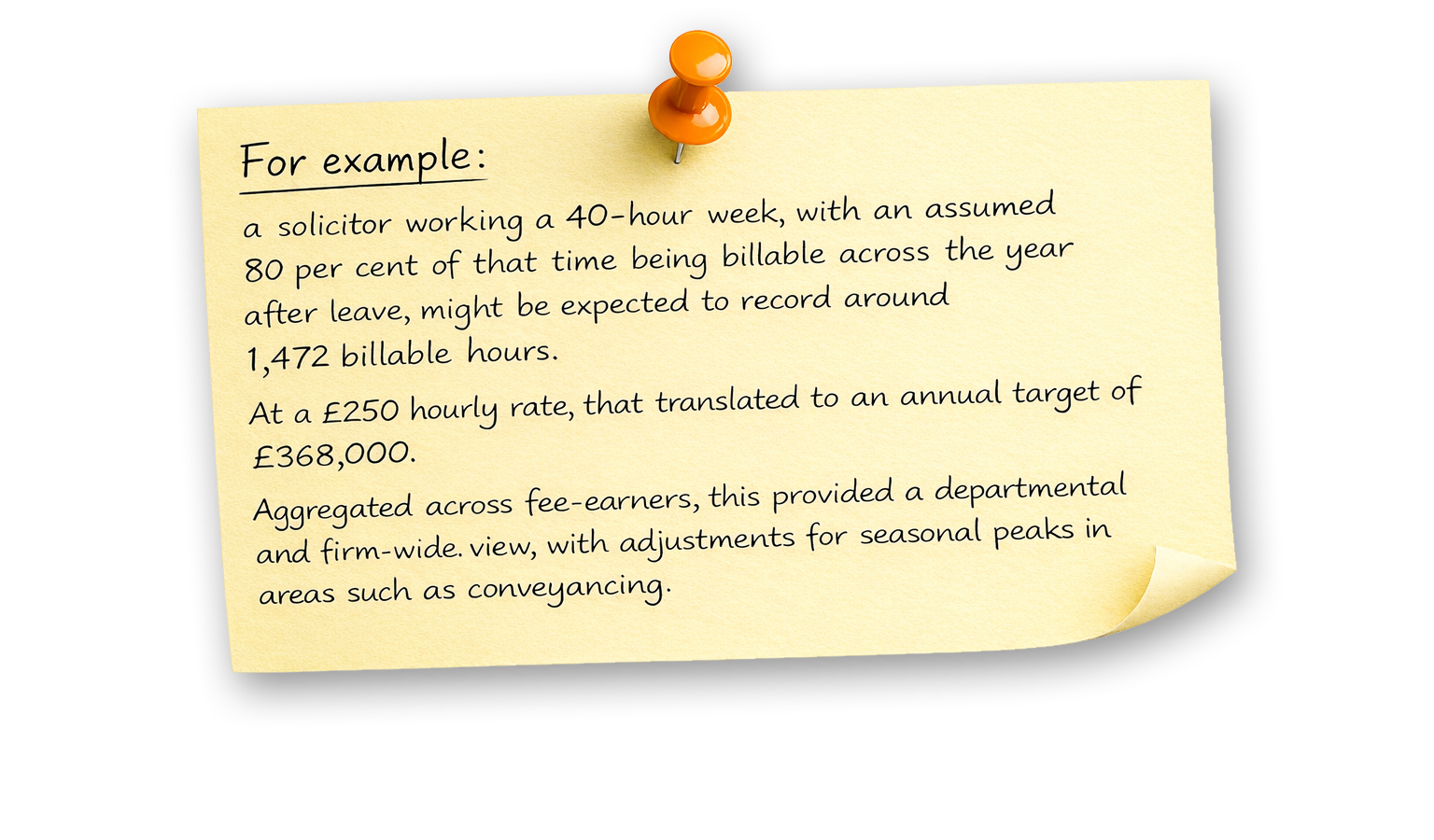
Drawing from my sales and commercial background, I provided guidance on setting realistic billing targets for fee-earners and departments. The approach started with actual billed fees from the previous year, then factored in charge-out rates, expected billable hours, non-chargeable time and capacity changes.
We also discussed using a balanced scorecard rather than focusing solely on billable hours. This included criteria such as client satisfaction, compliance and file management, contribution to the firm, and matter openings. The aim was to foster a performance culture that valued professionalism and client care as well as financial contribution.
The results
The combined impact of the repositioning, website expansion, SEO work, intake transformation and billing structure was substantial.

