
Website Design & Conversion | Discoverability & Lead Generation
CASE STUDY
Launching Brighton Health Clinic
with a Scalable Website
Achieving first-page search visibility
within three months
Services delivered:
Project summary
Brighton Health Clinic required a digital platform capable of supporting the launch and future development of a multidisciplinary private healthcare practice.
The project brought the clinic’s service model, patient pathways, governance requirements and local search strategy into one coherent system.

Initial outcomes:
Early evidence that the clinic's digital foundation was supporting both search visibility and patient discovery.
Client overview
Brighton Health Clinic is an independent private healthcare practice bringing medical, psychological, neurodevelopmental, occupational health and aesthetic services together in one clinical setting. The clinic was established around prompt access and a connected model of care. Patients could approach the practice through an individual service while benefiting from an organisation capable of considering related medical and psychological needs.
Its audience included adults, children and families, with an explicit commitment to inclusive care for neurodivergent people, LGBTQ+ patients and those seeking gender-affirming support. The proposition was clearly defined: clinically credible private healthcare delivered in a calm, inclusive and psychologically safe environment.

“We brought Mikey in to work on the website for Brighton Health Clinic, on a tight turnaround that didn't leave much room for error.
The work was on brand, SEO optimised, and mindful of the regulatory side that healthcare work always brings with it, all within the time and budget we had. The site reflects a genuine understanding of who our patients are and what they need.
Throughout it all he was easy to work with. Responsive, thoughtful, and someone who gets that in healthcare marketing, creativity and credibility have to sit side by side. I'd recommend him without hesitation.”
Stephanie BatesBrand & Marketing Lead
The challenge
Brighton Health Clinic was preparing to launch with an unusually broad clinical offer. Its website had to explain the breadth clearly, establish confidence in a new healthcare brand and provide practical routes into care.
One practice, several patient pathways
The clinic brought together private GP care, mental health, diagnostics, minor surgery, neurodevelopmental assessments, specialist clinical services, medical aesthetics and occupational health.
Each discipline required sufficient detail and visibility to stand independently. Collectively, they still had to read as one coherent model of care.
Clinical authority without institutional distance
The audience included people whose choice of provider could depend on as much on psychological safety and inclusion as clinical capability.
The experience therefore had to convey medical credibility without appearing cold or inaccessible. Language surrounding neurodivergence, mental health, LGBTQ+ healthcare and gender-affirming support required particular care.

Accessible routes into care, governed appropriately
Prospective patients needed to book, contact the clinic or identify the appropriate practice area without unnecessary friction.
Those routes also had to reflect the distinction between a general enquiry and a clinical interaction. Appointment activity belonged within Semble; the website’s callback form was intended for limited contact and service-routing information.
Immediate delivery with long-term utility
The website had to support launch within a compressed timeframe while remaining useful beyond it.
Search demand, mobile behaviour, future clinicians and the continued expansion of individual services all had implications for the initial structure.
The approach
The website was developed through a connected process of operational discovery, search research, content development and interface design. Each stage informed the next, allowing the clinic’s model of care shape both the structure of the site and the way prospective patients moved through it.
Establishing the architecture before design
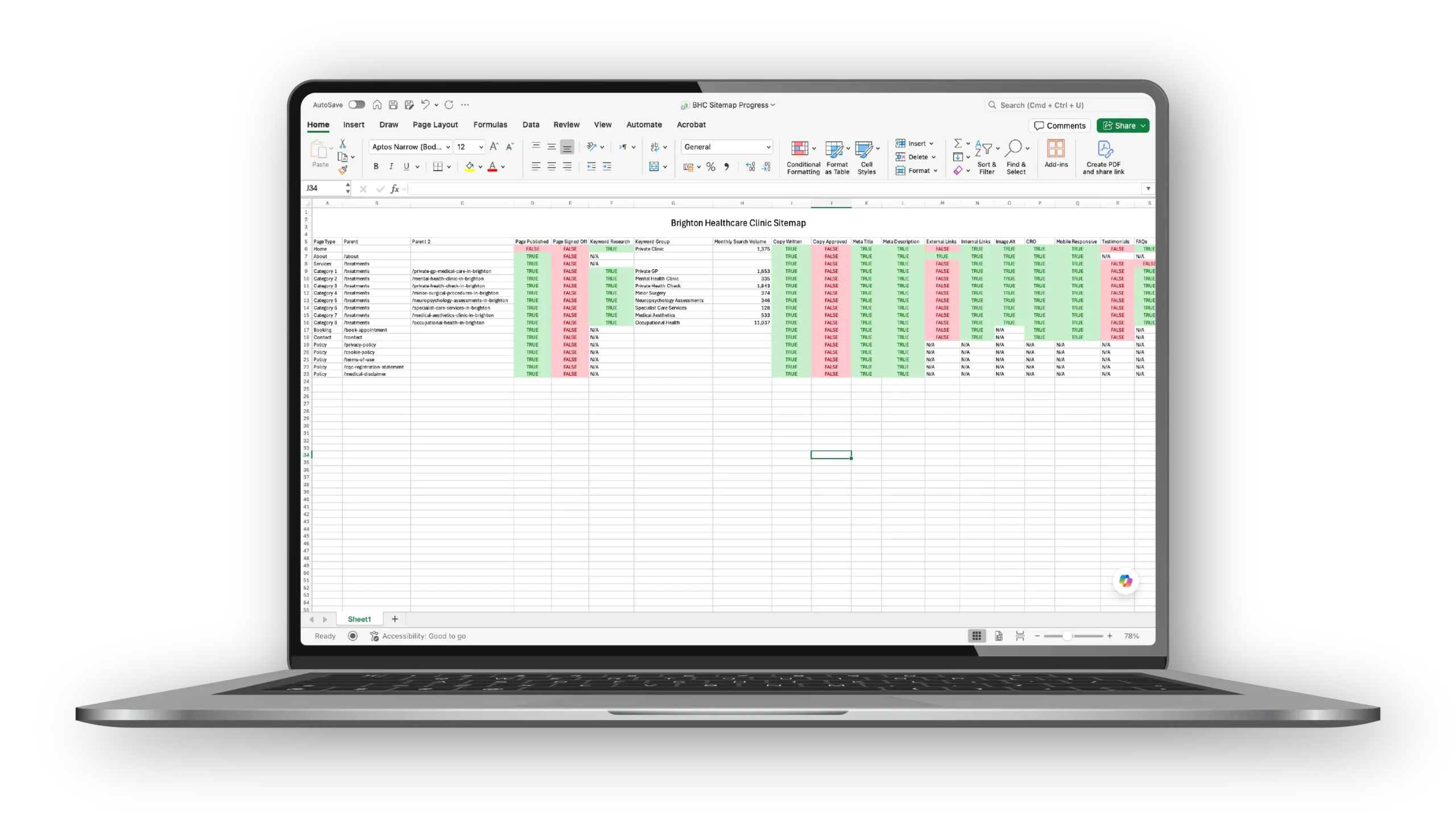
The project began by translating the clinical brief into a structured delivery plan. A page-level workbook defined the initial sitemap and recorded each page’s progress through research, copy approval, metadata, internal linking, accessibility, conversion and responsive checks.
Keyword research was conducted separately for the homepage and each principal practice area. Search intent and relative demand informed the terminology, page targeting and URL structure, establishing a clear distinction between the clinic’s overarching proposition and its service-specific search opportunities.
The resulting category structure also created room for expansion. More specialised treatments, assessments, and consultations could be introduced as child pages within an existing clinical and search hierarchy, without requiring the website to be reorganised.
Developing copy from clinical practice
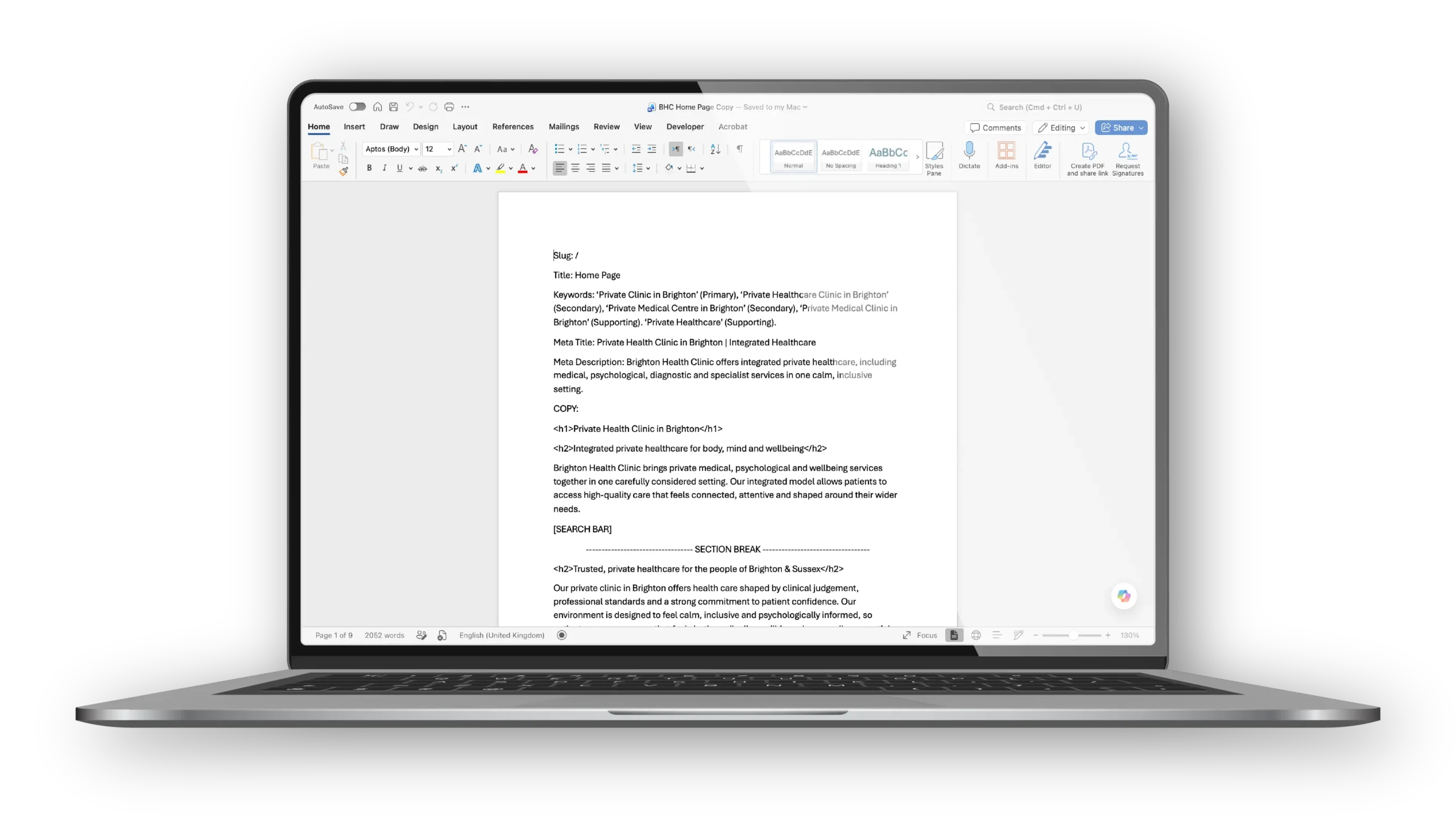
The copywriting process began with a tailored set of questions for each practice area. These established the scope of the service, its intended patients, how care would be delivered, what an appointment might involve and where clinical limitations needed to be communicated.
The answers provided an operational basis for the content. Each page reflected the service the clinic intended to deliver and addressed the information a prospective patient would reasonably need before making an enquiry.
Search terminology was reconciled with clinical detail rather than allowed to dictate it. Content relating to mental health, neurodivergence, LGBTQ+ healthcare and gender-affirming care used clear, non-stigmatising language and avoided assumptions about diagnosis, identity or outcome. The resulting copy was reviewed, refined and approved before publication.
Designing navigation around patient intent
The breadth of the clinic’s services required more than a conventional header menu. A bespoke service navigation was developed to help prospective patients identify the relevant practice area quickly, using dropdowns to expose the clinic’s principal disciplines without overcrowding the primary navigation.
The persistent header served a different purpose. It kept booking, contact and organisational information available as patients moved through longer pages, while reserving space for a future Team section once the clinic’s recruitment programme was complete.
Separating these functions made the navigation more purposeful: one route supported service discovery; the other maintained access to the actions mostly likely to follow it.
Translating the brand into a responsive interface
The supplied identity established the clinic’s palette, typography and visual character. These elements were developed into a broader interface system that could accommodate detailed clinical information while retaining the calm, premium quality set out in the brief.
Responsive behaviour was considered during the design rather than treated as a final adjustment. The hero areas were composed separately for desktop, tablet and mobile, giving each size and appropriate balance of imagery, messaging and calls to action. Navigation, content spacing and interaction points were similarly adapted for smaller devices, where most patient visits were expected to originate.
Bespoke coded elements, including the service-page bullet styling, extended the brand into the finer details of the interface and maintained visual consistency across the site.
Designing the booking pathway around information governance
The brief established a clear boundary for patient information: appointment booking was to be handled through Semble, with patient records and clinical data kept outside the website.
This requirement reflected established information-governance principles. GMC professional standards require patient information to be kept securely, limit its use to what is necessary and encourage administrative information to be managed separately from clinical records.
The website therefore supported two distinct routes. Patients ready to arrange care proceeded through Semble, while a general callback form collected only the contact and service-routing information required by reception. Detailed medical information was reserved for the appropriate clinical process.
The resulting pathway satisfied the operational brief while giving practical effect to data minimisation, confidentiality and secure records management.
Making governance visible
The information-governance decisions made within the booking pathway were supported by a broader set of website policies and regulatory statements.
A Privacy Policy distinguished website enquiries from patient records and clinical information. The Medical Disclaimer defined the limits of online content, clarified that submitting an enquiry did not establish a clinician-patient relationship and directed urgent concerns towards appropriate services. The Terms of Use addressed access to external systems, while the Cookie Policy explained consent, analytics and form-protection technologies. A separate CQC statement communicated the clinic’s regulated activities.
Together, these documents gave patients, clinicians and external stakeholders a clearer account of the website’s purpose, the boundaries of its communication channels and the organisation responsible for the service.
Extending the strategy into local search
The website was supported by a fully developed Google Business Profile, giving the clinic a structured presence across Google Search and Maps from launch.
The profile was configured with an appropriate primary category, supporting categories, defined service areas, opening hours and appointment information. Accessibility, inclusion and payment attributes were also documented, giving prospective patients practical information before visiting or making contact.
The service taxonomy established for the website was carried into the profile through an optimised clinic description and eight individual service descriptions. This created consistency between the searches through which patients discovered the clinic, the information presented within Google and the pages they reached on the website.
The results
The website reached sign-off-ready form within two weeks. Its initial reporting periods show early visibility across organic search, Google Search and Maps, alongside a clear foundation for continued expansion.
Performance Snapshot (1 April – 30 July 2026)

